
Bradshaw Gates • Fence & Gate Advice
October 27Custom Steel Gate Design Ideas: A Buyer's Style Guide
Last Updated: October 26, 2026
Quick Summary
A steel gate design should start with proportion: geometric patterns must repeat at a consistent scale so the gate reads as one structure, not a collection of bars. Match the pattern to what you are screening, since open bar, semi-private, and solid panels each block different sightlines and carry different wind loads. Choose the finish before fabrication, and we recommend matte black, charcoal, and bronze for most homes.
- Scale geometric patterns large enough that the design stays visible from the road on wide driveway gates.
- Semi-private laser-cut or perforated panels, roughly 30-60% open, balance screening and wind resistance for most homes.
- Solid panels under about 15% open act as a sail, requiring heavier posts, hinges, and operator torque.
- Cantilever sliding gates need a fence-line run about 1.5 times the opening width and avoid track maintenance entirely.
- A hot-dip galvanized core with a powder coat topcoat is the finish combination that lasts in humid or storm-prone regions.
Table of Contents
- Modern Steel Gate Designs: Clean Lines and Strong First Impressions
- Geometric Patterns and Architectural Lines
- Ornamental and Wrought-Iron-Inspired Details
- Steel Gate Privacy Designs for Driveways, Gardens, and Front Entries
- Matching the Pattern to What You Are Screening
- The Wind-Load Consequence Nobody Mentions
- Airflow, Heat, and Maintenance
- A Quick Selection Method
- Sliding Gate vs Swing Gate for Driveway Entrances
- Slope and Clearance Decide More Than Style
- Hardware, Posts, and Automation
- Installation Constraints to Check Before You Choose
- Steel Gate Patterns and Finishes That Hold Up Outdoors
- Matching a Custom Gate to Your Property, Terrain, and Budget
- Get a Quote on a Custom Steel Gate Built for Your Property
- Frequently Asked Questions
Modern Steel Gate Designs: Clean Lines and Strong First Impressions
A custom steel gate design ideas project starts with one decision: what should the gate say before anyone reaches your door? At Bradshaw Gates, we build steel entry gates for homes and commercial properties across the Four-State area.
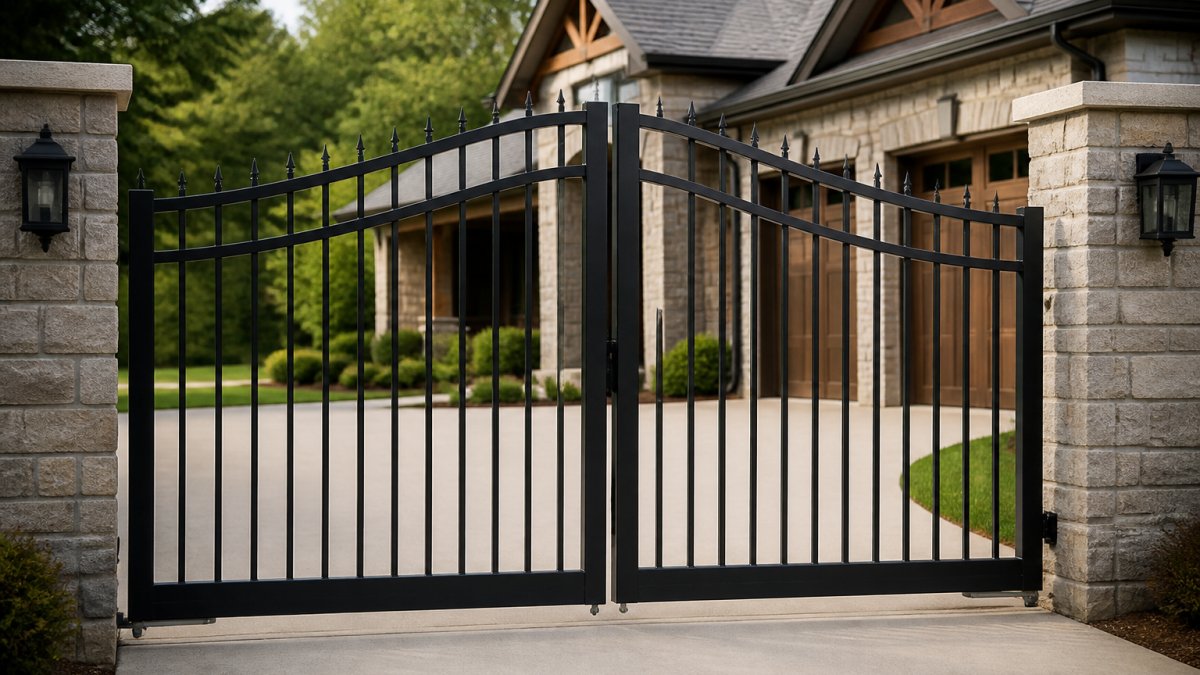
Modern black steel gate design with horizontal bars and geometric panels at a driveway entrance during golden hourGeometric Patterns and Architectural Lines
Steel gate design lives or dies on proportion. Geometric patterns work because they repeat at a consistent scale, so the eye reads the gate as one structure rather than a collection of bars. A common mistake is scaling a pattern too small on a wide driveway gate; the design disappears from the road.
Ornamental and Wrought-Iron-Inspired Details
The American Welding Society publishes guidance on structural welding that reputable fabricators follow, which matters when decorative elements also carry load.
Steel Gate Privacy Designs for Driveways, Gardens, and Front Entries
| Privacy Level | Typical Open Area | What It Blocks | Wind and Hardware Effect |
|---|---|---|---|
| Open bar or slat | Roughly 70-90% open | Almost nothing; defines the entry line | Lowest wind load; lightest posts and hinges |
| Semi-private (laser-cut, perforated, spaced slats) | Roughly 30-60% open | Silhouettes and casual sightlines from the road | Moderate load; posts and hinges sized up from open designs |
| Solid sheet or closely spaced pickets | Under about 15% open | Most of the view; near-total screening | Acts as a sail; heaviest posts, hinges, and operator torque |
Matching the Pattern to What You Are Screening
- Street-facing driveway: the target is vehicle and pedestrian sightlines from the road. A semi-private pattern with a solid lower band and an open upper section screens headlights and parked cars while keeping the gate from reading as a wall.
- Side yard or pool area: the goal is often screening from a neighbor's second story. Height matters more than density here, and a taller open-bar gate can outperform a shorter solid one.
- Garden and backyard gates: full privacy usually works against you. A mid-height panel with a decorative cutout keeps sightlines into the planting while marking the boundary, letting the garden read as depth instead of a dead end.
- Front entry walkway gates: these are seen up close, so pattern quality matters more than open area. A laser-cut panel with a repeating motif gives eye-level privacy without the fortress look of a solid sheet.
The Wind-Load Consequence Nobody Mentions
A solid gate on a wide driveway is the most common privacy mistake. Wind pressure rises with the square of wind speed, so doubling the exposed area multiplies the load rather than doubling it. A solid panel on a 12- to 16-foot opening needs heavier posts, hinges, and a stronger operator than the same opening with a semi-private pattern. On automated gates, the extra sail area strains the motor and drives more service calls.
Airflow, Heat, and Maintenance
Open area also affects how the gate ages. Solid panels trap moisture and debris along the bottom rail, where rust usually starts. Perforated and laser-cut panels drain and dry faster and let you see the frame and welds, making early corrosion easier to catch. On garden gates, airflow reduces the humid pocket that accelerates coating failure on the lower half.
A Quick Selection Method
- Full privacy: solid steel sheet or tightly spaced pickets, best for street-facing driveways where screening matters more than wind exposure
- Partial privacy: laser-cut or perforated panels, the best balance of screening and wind resistance for most homes
- Low privacy: open bar designs, maximum visibility and airflow, and the easiest gate to automate and maintain
Sliding Gate vs Swing Gate for Driveway Entrances
| Gate Type | Space Needed | Typical Opening Range | Best For | Watch Out For |
|---|---|---|---|---|
| Sliding (track) | A run along the fence roughly equal to the opening width, plus a level track | Commonly about 10-20 ft | Short or steep driveways with fence-line room | Track clogs with debris; ground must be level and stable |
| Cantilever sliding | A fence-line run roughly 1.5 times the opening width for counterbalance | Commonly about 10-24 ft | Uneven terrain, no room for a ground track | Heavier counterweight and hardware; higher cost |
| Swing (single) | A clear arc in front of or behind the gate roughly equal to the opening width | Commonly about 3-12 ft per leaf | Flat ground with room to open | Slope clearance; wind load on solid panels |
| Swing (double) | Two arcs, one per leaf | Commonly about 12-24 ft total | Wide driveways on flat ground | Two operators if automated; center alignment |
Slope and Clearance Decide More Than Style
Clearance behind the gate matters just as much. A swing gate opening inward needs the full arc clear of parked cars, landscaping, and the garage approach. On a short driveway, the gate opens into the vehicle's path, inconvenient, and a safety issue on automated gates.
Hardware, Posts, and Automation
Gate type changes what the hardware has to do:
Get a Quote →
- Swing gates load hinges and posts in tension and bending, so post footing size and hinge quality carry the design. Automated swing gates need an operator with a manual release for power outages.
- Track sliding gates carry weight on rollers and a ground track, so the track and its foundation take the load. Debris in the track is the most common service issue.
- Cantilever sliding gates carry weight on a counterbalanced beam and a pair of carriages, so foundation and beam sizing matter more than the ground surface. They cost more but avoid track maintenance entirely.
On any automated gate, safety devices are part of the design, not an add-on. Photoelectric sensors, edge sensors, and posted warning signs are standard for a residential automated gate, and the operator should include a manual release. Plan the conduit and power run before the posts go in, retrofitting power to a finished gate costs far more than trenching during installation.
Installation Constraints to Check Before You Choose
- Opening width: measure the finished clear opening, not the fence line. A gate sized to the fence line leaves gaps or forces a rebuild.
- Grade: note the slope across the opening and along the intended slide run. Swing gates tolerate less grade than sliding gates.
- Soil and drainage: sandy or poorly drained soil changes footing design, especially for cantilever gates with concentrated loads.
- Obstructions: check for irrigation lines, downspouts, and utility easements along the slide run or swing arc.
Steel Gate Patterns and Finishes That Hold Up Outdoors
Finish choice decides how a gate looks in year five, not year one. Powder coating offers the widest color range and a durable shell, while galvanized steel underneath provides corrosion protection paint alone cannot match. In humid or storm-prone regions, a hot-dip galvanized core with a powder coat topcoat is the combination that lasts. Steel gate patterns and finishes should be chosen together: dark colors hide rust streaks, lighter colors show every mark.
Matching a Custom Gate to Your Property, Terrain, and Budget
The gate that fits your property is not always the gate you pinned first. Slope, soil, wind exposure, and opening width all shape what will work. A common mistake is ordering a gate sized to the fence line rather than the finished opening, which leaves gaps or forces a rebuild.
Before you commit, run through this checklist:
Get a Quote on a Custom Steel Gate Built for Your Property
Steep slopes, odd angles, and uneven terrain are where custom fabrication earns its keep. Bradshaw Gates fabricates steel gates and fencing, with solid posts and careful alignment. We also diagnose and repair gate openers. Get a quote from Bradshaw Gates and get a steel gate built right for your property.
Frequently Asked Questions
What are the most popular custom steel gate design ideas?
Modern horizontal-bar gates, geometric laser-cut panels, and ornamental scrollwork remain the most requested styles. Homeowners with long driveways often pair a decorative steel gate design with matching fence panels for a consistent look, while garden and front-entry gates lean toward finer patterns. The right choice depends on your home's architecture, how much privacy you want, and how much wind or traffic the gate will face.
What steel gate design offers the most privacy?
Solid or semi-solid infill panels give the most privacy. Steel gate privacy designs use closely spaced vertical bars, perforated or laser-cut sheet panels, or solid metal panels that block sightlines from the road. Keep in mind that solid panels catch more wind, so posts and hinges need to be sized for the load. A fabricator can balance privacy, airflow, and structural strength for your specific opening.
Should I choose a sliding or swing steel gate?
It comes down to space and terrain. Swing gates need clearance to open inward or outward, so they suit shorter driveways with flat ground. Sliding gates run parallel to a fence line and work well on slopes or where the driveway is steep or short on turning room. Automation is available for both, but sliding gates generally need a longer, level track area, so measure your site before deciding.
What finishes help protect a steel gate from rust?
Powder coating is the most common finish because it seals the steel against moisture and comes in a wide range of colors. Hot-dip galvanizing adds a zinc layer for extra corrosion protection, which matters in humid or coastal climates. Regular maintenance, such as touching up scratches and washing off dirt and road salt, extends the life of any finish. Ask your fabricator which coating suits your local weather.
Get a Quote Add bradshawgates.com as a preferred source on Google →Frequently Asked Questions
What are the most popular custom steel gate design ideas?
Modern horizontal-bar gates, geometric laser-cut panels, and ornamental scrollwork remain the most requested styles. Homeowners with long driveways often pair a decorative steel gate design with matching fence panels for a consistent look, while garden and front-entry gates lean toward finer patterns. The right choice depends on your home's architecture, how much privacy you want, and how much wind or traffic the gate will face.
What steel gate design offers the most privacy?
Solid or semi-solid infill panels give the most privacy. Steel gate privacy designs use closely spaced vertical bars, perforated or laser-cut sheet panels, or solid metal panels that block sightlines from the road. Keep in mind that solid panels catch more wind, so posts and hinges need to be sized for the load. A fabricator can balance privacy, airflow, and structural strength for your specific opening.
Should I choose a sliding or swing steel gate?
It comes down to space and terrain. Swing gates need clearance to open inward or outward, so they suit shorter driveways with flat ground. Sliding gates run parallel to a fence line and work well on slopes or where the driveway is steep or short on turning room. Automation is available for both, but sliding gates generally need a longer, level track area, so measure your site before deciding.
What finishes help protect a steel gate from rust?
Powder coating is the most common finish because it seals the steel against moisture and comes in a wide range of colors. Hot-dip galvanizing adds a zinc layer for extra corrosion protection, which matters in humid or coastal climates. Regular maintenance, such as touching up scratches and washing off dirt and road salt, extends the life of any finish. Ask your fabricator which coating suits your local weather.
Planning a fence or gate project?
Bradshaw Gates serves Northeast Oklahoma and the Four-State area.
Request a Quote Call 918-325-0057