
Bradshaw Gates • Fence & Gate Advice
November 7How to Build a Fence on Sloped Terrain Step by Step
Quick Summary
Build a fence on sloped terrain by first measuring the grade with a string line and level, then choosing a stepped or racked layout. Stepped fences suit steep slopes, while racked fences follow gentle grades. Set each post to its target height, plumb it in two directions, and cut rails to match your chosen method.
- Measure rise over run with a string line and level, then divide by run and multiply by 100 for slope percentage.
- Use a stepped fence above about 15 percent slope and a racked fence below it.
- Bury about one-third of the post height plus 6 inches of gravel, and check hole depth on the uphill side.
- Check every post plumb in two directions and verify post tops before cutting rails.
- Leave weep gaps or use mesh at the bottom rather than a solid board where water flows downhill.
Table of Contents
- Measure the Slope and Mark the Fence Line
- Worked Example: Calculating Rise Over Run
- Choose Between a Stepped Fence and a Racked Fence
- How to Level Fence Posts on Uneven Ground
- How to Install Fence Rails on a Slope
- Choosing the Best Fence for Uneven Ground and Closing Bottom Gaps
- Schedule a Site Assessment for Your Sloped Property
- Frequently Asked Questions
Measure the Slope and Mark the Fence Line
Building a fence on sloped terrain starts with knowing exactly how steep your ground is, because the grade shapes every decision that follows. Measuring before you buy a single post is the first step on any uneven yard. Skipping it can leave gaps, leaning posts, or rails that do not line up.
The easiest way to measure slope is with a string line and a level. Drive a stake at each end of the planned fence line, tie the string to the high stake, pull it taut, and level it horizontally. Measure from the string down to the ground at the low stake: that number is your rise.
Slopes in the 10 to 20 percent range are common on residential lots. That range can be built with either fence method, but it changes how much material you need and how you set each post.
Worked Example: Calculating Rise Over Run
Say your fence line runs 40 feet between two stakes. The string sits 4 feet above the ground at the low stake. Your rise is 4 feet and your run is 40 feet.
To find the slope percentage, divide the rise by the run and multiply by 100:
- 4 ÷ 40 = 0.10
- 0.10 × 100 = 10 percent slope
Now you know the grade. A 10 percent slope means the ground drops 1 foot for every 10 feet of horizontal distance. Write this number down; you will need it when you pick a fence method and calculate how many pickets or panels to buy.
Mark your post locations with flags or spray paint at your planned spacing, usually 6 to 8 feet for wood fences, and check that each mark sits along the string line.
Choose Between a Stepped Fence and a Racked Fence
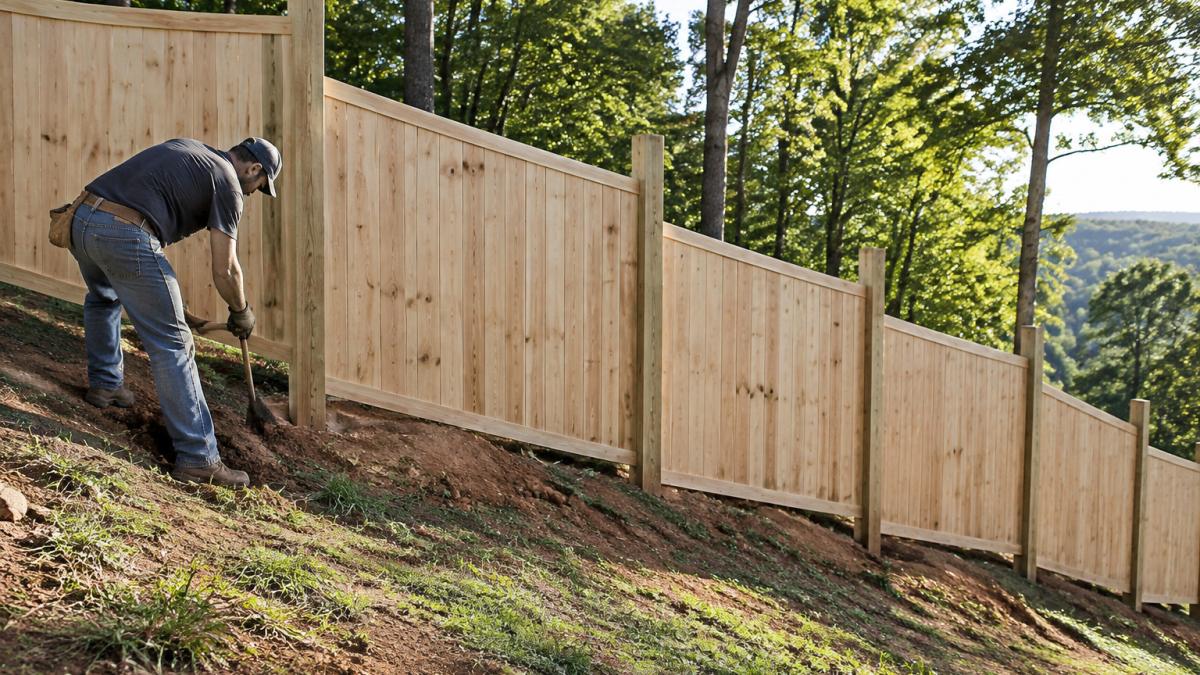
There are two main ways to handle a slope. A stepped fence keeps each panel level and drops the whole section down in steps. A racked fence follows the slope, so the rails and pickets stay parallel to the ground.
Stepped fences work best when:
- The slope is steep, usually above 15 percent
- You want clean, level rails for a finished look
- You are using pre-built panels that cannot bend
Racked fences work best when:
- The slope is gentle, usually below 15 percent
- You want a smooth, continuous line
- You are building with boards or pickets you can cut on site
Many yards use both. Rack the fence along a gentle section and step it down at the steepest drop. Choosing the right method for each section is the fastest way to a fence that looks right and works well.
How to Level Fence Posts on Uneven Ground
Start by converting your slope measurement into post heights.
Hole depth is where sloped ground punishes shortcuts. A common rule is that the buried portion should equal roughly one-third of the above-ground post height, plus 6 inches of gravel at the bottom.
Follow these steps for each post:
- Dig the hole to the depth your post height and frost conditions require, plus 6 inches for gravel
- Add 4 to 6 inches of gravel and tamp it flat so the post does not sink later
- Set the post and check plumb with a level on two adjacent faces, not just one
- Brace the post with 2x4s and stakes so it cannot move while the concrete cures
- Pour concrete, slope the top slightly away from the post so water runs off, and let it cure at least 24 hours before loading rails
A common mistake is pouring concrete before the post is plumb in both directions. Once the mix sets, you cannot correct the angle without breaking out the concrete. Check the level twice, then check it again after bracing.
Watch out: On a slope, water running down the hill can erode the soil around the downhill side of a post and leave the concrete collar exposed.
If you are setting posts in a stepped layout, run a string line at the target height of each step and set a post at every step break plus intermediate posts at your normal spacing.
How to Install Fence Rails on a Slope
Rails tie the posts together and carry the weight of the pickets or panels. On a slope, the rails must match your chosen method.
Contractor installing a horizontal fence rail between posts on a sloped terrain with tools on the grassFor a stepped fence, cut each rail to fit between two posts that sit at the same height. Attach the rails with galvanized brackets or through-bolts. The rail stays level from end to end.
For a racked fence, the rails follow the grade. Measure the angle with a level and mark the cut ends to match. Attach the rails so they run parallel to the ground surface.
Attach rails at the top, middle, and bottom of the fence for strength. On taller fences, add a fourth rail near the middle of the upper section. Use exterior-rated screws or bolts, since moisture on a slope can speed up rust and rot.
Here is a quick summary of rail placement by fence height:
| Fence Height | Number of Rails | Rail Placement |
|---|---|---|
| 4 feet | 2 | Top and bottom |
| 6 feet | 3 | Top, middle, and bottom |
| 8 feet | 4 | Top, two middle, and bottom |
Choosing the Best Fence for Uneven Ground and Closing Bottom Gaps
The best fence for uneven ground depends on your slope, your budget, and what the fence needs to do, but the material choice also changes how you handle the slope itself.
Wood is the most forgiving material on a slope because you can cut rails and pickets on site to follow grade or step down in clean increments.
Vinyl looks clean and needs little upkeep, but most vinyl panels are manufactured to fixed dimensions, which pushes you toward a stepped layout.
Metal panels and ornamental steel handle slope well because posts and rails can be cut and fit on site, and the material resists warping and rot.
Bottom gaps are the most common complaint on sloped fences, and how you close them depends on what the gap needs to do. A stepped fence leaves a triangular gap under each level panel; a racked fence leaves a smaller, more uniform gap that follows the ground. Close the gap with one of these approaches:
- Add a rot-resistant skirt board below the lowest rail, cut to follow grade on a racked fence or stepped to match each panel on a stepped fence
- Install a mesh panel or hardware cloth behind the skirt to keep small pets in and wildlife out while still letting water pass
- Trim racked pickets so they sit about 2 to 4 inches above the ground, which keeps the fence off wet soil and reduces rot
- Use a gravel or river-rock strip along the bottom to slow erosion and hide small gaps without blocking drainage
Watch out: Sealing the bottom gap completely with a solid board can trap water against the fence and speed rot, especially on the downhill side where runoff collects.
Schedule a Site Assessment for Your Sloped Property
Every sloped yard is different. Rock, soil type, drainage, and property lines all affect how a fence should be built. A site assessment lets a professional check these details before any digging starts.
Before you dig, call 811 to have underground utility lines marked (811 Before You Dig).
Ready to get started? Request a quote from Bradshaw Gates to discuss your sloped property.
Frequently Asked Questions
How do you build a fence on sloped terrain?
Start by measuring the slope with a level, string line and tape to find the rise over the run of the fence line. Decide whether the fence will step down in level sections or follow the grade with racked panels. Set each post to its own height so the top of the fence stays consistent with the ground, then attach rails and pickets or panels. Check plumb and alignment on every post before the concrete sets. Pricing depends on materials, fence length, and site conditions, so request a quote from Bradshaw Gates for current figures.
Should a fence on a slope be stepped or follow the ground?
A stepped fence keeps each panel level and drops in fixed increments, which gives clean horizontal lines and makes rails straightforward to install. A racked fence follows the grade, so the top rail and pickets slope with the ground, which suits a continuous look but requires cutting angled pickets. Stepped fences often leave larger gaps at the bottom of each step, while racked fences keep bottom gaps more even. Choose based on how steep the grade is and how important the fence appearance is to the property.
How do you keep gaps under a fence on sloped ground?
Cut each picket or panel to match the ground at its location, leaving a consistent gap of a few inches for drainage and airflow. Where pets or small animals need to be contained, reduce the gap or add a bottom board or mesh. Consider erosion and soil settling over time, and add gravel or a rock bed at low points where water collects. Adjust any gap that grows after the first rain, since drainage can wash soil away under panels.
How do you install fence panels on a sloped yard?
Set posts at the planned spacing, adjusting the height of each post to the grade so the post tops fall on a consistent line. Install prefabricated panels in a stepped or racked arrangement depending on the slope, and secure them to the posts with brackets or screws. Confirm that each panel is level or follows the planned angle before fastening. Check property lines and any local permit requirements before digging, and call 811 to locate underground utilities before setting posts.
Add bradshawgates.com as a preferred source on Google →Frequently Asked Questions
How do you build a fence on sloped terrain?
Start by measuring the slope with a level, string line and tape to find the rise over the run of the fence line. Decide whether the fence will step down in level sections or follow the grade with racked panels. Set each post to its own height so the top of the fence stays consistent with the ground, then attach rails and pickets or panels. Check plumb and alignment on every post before the concrete sets. Pricing depends on materials, fence length, and site conditions, so request a quote from Bradshaw Gates for current figures.
Should a fence on a slope be stepped or follow the ground?
A stepped fence keeps each panel level and drops in fixed increments, which gives clean horizontal lines and makes rails straightforward to install. A racked fence follows the grade, so the top rail and pickets slope with the ground, which suits a continuous look but requires cutting angled pickets. Stepped fences often leave larger gaps at the bottom of each step, while racked fences keep bottom gaps more even. Choose based on how steep the grade is and how important the fence appearance is to the property.
How do you keep gaps under a fence on sloped ground?
Cut each picket or panel to match the ground at its location, leaving a consistent gap of a few inches for drainage and airflow. Where pets or small animals need to be contained, reduce the gap or add a bottom board or mesh. Consider erosion and soil settling over time, and add gravel or a rock bed at low points where water collects. Adjust any gap that grows after the first rain, since drainage can wash soil away under panels.
How do you install fence panels on a sloped yard?
Set posts at the planned spacing, adjusting the height of each post to the grade so the post tops fall on a consistent line. Install prefabricated panels in a stepped or racked arrangement depending on the slope, and secure them to the posts with brackets or screws. Confirm that each panel is level or follows the planned angle before fastening. Check property lines and any local permit requirements before digging, and call 811 to locate underground utilities before setting posts.
Planning a fence or gate project?
Bradshaw Gates serves Northeast Oklahoma and the Four-State area.
Request a Quote Call 918-325-0057